Benefits of the Captive Model

Total control
Every decision, from hiring to IP protection, sits with the company.
Total control
Every decision, from hiring to IP protection, sits with the company.

Stronger data & IP security
Sensitive work never passes through a third party’s systems, even briefly.
Stronger data & IP security
Sensitive work never passes through a third party’s systems, even briefly.

Deeper cultural alignment
Direct hires integrate into company culture and global reporting lines faster than a vendor-managed workforce typically does.
Deeper cultural alignment
Direct hires integrate into company culture and global reporting lines faster than a vendor-managed workforce typically does.
No transfer cost or transition risk
Since there’s no handover planned, there’s nothing to disrupt operations down the line.
No transfer cost or transition risk
Since there’s no handover planned, there’s nothing to disrupt operations down the line.
The Problem It Solves
Many companies reach a point where a managed or transitional setup stops making sense:
Growth has outpaced what a shared or partner-run structure can support cleanly
Leadership wants direct accountability over hiring, compliance, and delivery not a layer of vendor management
The work involves sensitive IP or data that shouldn’t sit inside a third party’s systems, even temporarily
The company already has enough India experience to manage setup without outside support
How a Captive GCC Actually Works
01
Entity setup
The parent company registers its own legal entity in India — no shared or intermediary structure involved.
02
Leadership hiring
A local leadership team is brought on first, typically reporting directly into global functions, since they’ll run the center’s day-to-day decisions.
03
Talent acquisition
Every hire is a direct employee of the company. There’s no vendor sourcing or staffing layer.
04
Infrastructure & compliance
Office space, IT systems, data governance, and regulatory compliance are built and owned by the company from day one.
05
Scale-up
Once the founding team and processes are in place, the center scales headcount and scope based entirely on the company’s own roadmap.
How a Captive GCC Actually Works
01
Entity setup
The parent company registers its own legal entity in India — no shared or intermediary structure involved.
02
Leadership hiring
A local leadership team is brought on first, typically reporting directly into global functions, since they’ll run the center’s day-to-day decisions.
03
Talent acquisition
Every hire is a direct employee of the company. There’s no vendor sourcing or staffing layer.
04
Infrastructure & compliance
Office space, IT systems, data governance, and regulatory compliance are built and owned by the company from day one.
05
Scale-up
Once the founding team and processes are in place, the center scales headcount and scope based entirely on the company’s own roadmap.


Benefits of the Captive Model
Total control
Every decision, from hiring to IP protection, sits with the company.
Stronger data & IP security
Sensitive work never passes through a third party’s systems, even briefly.
Deeper cultural alignment
Direct hires integrate into company culture and global reporting lines faster than a vendor-managed workforce typically does.
No transfer cost or transition risk
Since there’s no handover planned, there’s nothing to disrupt operations down the line.
The Problem It Solves
Many companies reach a point where a managed or transitional setup stops making sense:
The Problem It Solves
Growth has outpaced what a shared or partner-run structure can support cleanly
Leadership wants direct accountability over hiring, compliance, and delivery not a layer of vendor management
The work involves sensitive IP or data that shouldn’t sit inside a third party’s systems, even temporarily
The company already has enough India experience to manage setup without outside support
Captive GCC Model
Captive GCC Model
Full Ownership, Full Control from Day One
Full Ownership, Full Control from Day One
Full Ownership, Full Control from Day One
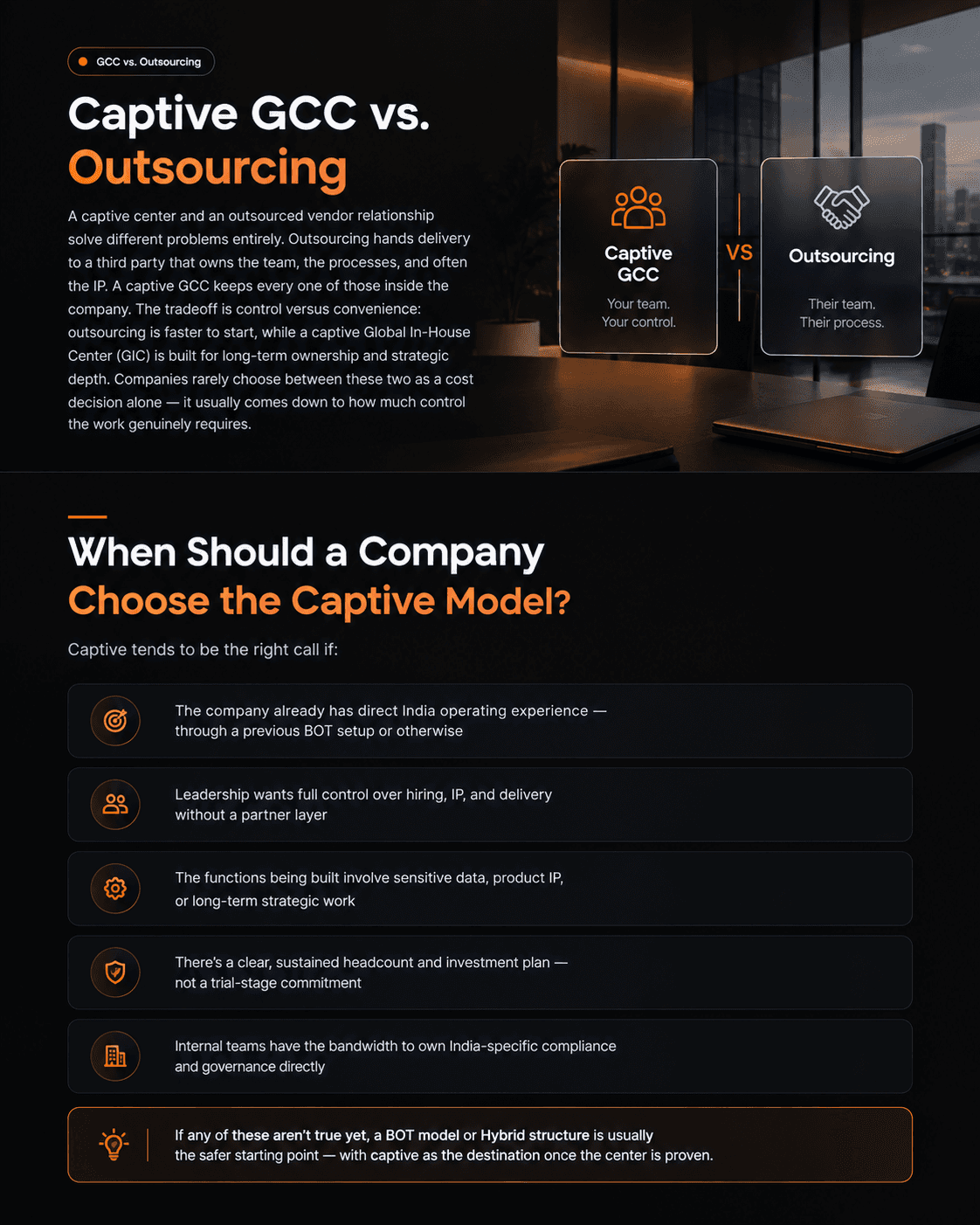
A captive GCC is the model companies move toward once they’re certain India is a permanent part of how they operate not a trial. The parent company owns and runs the center entirely: the entity, the team, the technology, and the IP, with no partner between the business and its offshore operations.
A captive GCC is the model companies move toward once they’re certain India is a permanent part of how they operate not a trial. The parent company owns and runs the center entirely: the entity, the team, the technology, and the IP, with no partner between the business and its offshore operations.
Disadvantages to Weigh
The captive model isn’t the lowest-risk entry point, and it’s worth being clear about that. Setup takes longer, since the company manages entity registration, compliance, and hiring directly rather than relying on a partner’s existing playbook. It also demands more upfront investment and internal bandwidth — someone on the company’s side has to own India strategy actively, not just sign off on a partner’s plan. Companies without prior India experience often find this stage harder to get right on the first attempt.
CAPTIVE
Hybrid
BOT

Captive vs. BOT vs. Hybrid
CAPTIVE
Hybrid
BOT
CAPTIVE
Hybrid
BOT